AOV網(Activity On Vertex Network)中頂點代表活動,有向邊代表先後依賴關係。拓撲排序將偏序集轉換為線性序列,是編譯器依賴分析、構建系統、課程規劃等領域的核心算法。本文提供基於鄰接表的完整C語言實現,包含圖構建、入度計算、棧式拓撲排序及環檢測全流程。
// 定位頂點索引
int LocateVex(ALGraph *G, char *name) {
    for (int i = 0; i < G->vexNum; i++)
        if (strcmp(G->vertices[i].data, name) == 0) return i;
    return -1;
}

// 創建圖(支持4種類型)
int CreateGraph(ALGraph *G) {
    printf("圖類型(0有向圖 1有向網 2無向圖 3無向網): ");
    scanf("%d", &G->kind);

    printf("頂點數 邊數: ");
    scanf("%d %d", &G->vexNum, &G->arcNum);

    printf("輸入%d個頂點名(<%d字符): ", G->vexNum, MAX_NAME_LEN);
    for (int i = 0; i < G->vexNum; i++) {
        scanf("%s", G->vertices[i].data);
        G->vertices[i].first = NULL;
    }

    if (G->kind == 1 || G->kind == 3) // 網
        printf("輸入每條邊: 權值 起點 終點\n");
    else
        printf("輸入每條邊: 起點 終點\n");

    for (int k = 0; k < G->arcNum; k++) {
        int w; char va[MAX_NAME_LEN], vb[MAX_NAME_LEN];
        if (G->kind == 1 || G->kind == 3)
            scanf("%d %s %s", &w, va, vb);
        else
            scanf("%s %s", va, vb);

        int i = LocateVex(G, va);
        int j = LocateVex(G, vb);
        if (i == -1 || j == -1) return 0;

        // 插入邊 i->j
        ArcNode *p = malloc(sizeof(ArcNode));
        p->adjvex = j;
        p->info = (G->kind == 1 || G->kind == 3) ? malloc(sizeof(int)) : NULL;
        if (p->info) *p->info = w;
        p->next = G->vertices[i].first;
        G->vertices[i].first = p;

        // 無向圖/網添加反向邊
        if (G->kind >= 2) {
            ArcNode *q = malloc(sizeof(ArcNode));
            q->adjvex = i;
            q->info = (G->kind == 3) ? malloc(sizeof(int)) : NULL;
            if (q->info) *q->info = w;
            q->next = G->vertices[j].first;
            G->vertices[j].first = q;
        }
    }
    return 1;
}
// 計算所有頂點入度
void CalcInDegree(ALGraph *G, int *indeg) {
    for (int i = 0; i < G->vexNum; i++) indeg[i] = 0;
    for (int i = 0; i < G->vexNum; i++) {
        ArcNode *p = G->vertices[i].first;
        while (p) {
            indeg[p->adjvex]++;
            p = p->next;
        }
    }
}

// 拓撲排序主函數
int TopologicalSort(ALGraph *G) {
    int indeg[MAX_VERTICES];
    CalcInDegree(G, indeg);

    SqStack S;
    InitStack(&S);

    // 入度為0的頂點入棧
    for (int i = 0; i < G->vexNum; i++)
        if (indeg[i] == 0) Push(&S, i);

    int count = 0;
    printf("拓撲序列: ");

    while (!StackEmpty(&S)) {
        int u;
        Pop(&S, &u);
        printf("%s ", G->vertices[u].data);
        count++;

        // 遍歷u的出邊,減少終點入度
        ArcNode *p = G->vertices[u].first;
        while (p) {
            int v = p->adjvex;
            if (--indeg[v] == 0) Push(&S, v);
            p = p->next;
        }
    }

    printf("\n");

    if (count < G->vexNum) {
        printf("圖中存在環,無法拓撲排序\n");
        return 0;
    }
    printf("有效拓撲序列\n");
    return 1;
}
kind], G->vexNum, G->arcNum);

    for (int i = 0; i < G->vexNum; i++) {
        ArcNode *p = G->vertices[i].first;
        while (p) {
            if (G->kind <= 1) { // 有向
                printf("%s->%s", G->vertices[i].data, G->vertices[p->adjvex].data);
                if (G->kind == 1) printf(":%d", *p->info);
            } else { // 無向,避免重複輸出
                if (i < p->adjvex) {
                    printf("%s--%s", G->vertices[i].data, G->vertices[p->adjvex].data);
                    if (G->kind == 3) printf(":%d", *p->info);
                }
            }
            p = p->next;
        }
        printf("\n");
    }
}
測試用例與結果
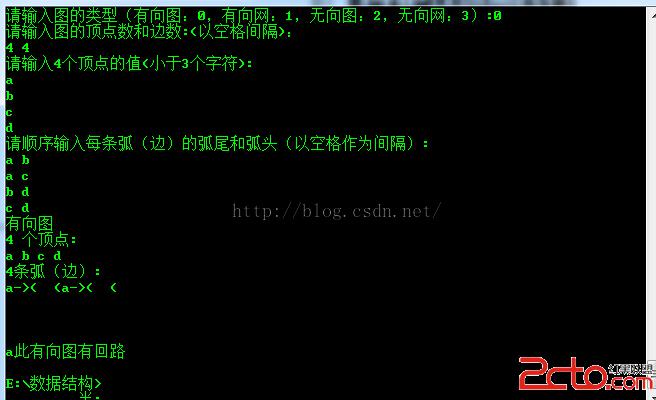
輸入: 圖類型: 0 (有向圖) 頂點數: 6, 邊數: 7 頂點: V0 V1 V2 V3 V4 V5 邊: V0 V1 V0 V2 V1 V3 V2 V3 V3 V4 V2 V5 V4 V5 輸出: 有向圖: 6頂點 7邊 V0->V1 V0->V2 V1->V3 V2->V3 V2->V5 V3->V4 V4->V5 拓撲序列: V0 V1 V2 V3 V4 V5 有效拓撲序列算法複雜度與正確性證明
| 指標 | 複雜度 | 說明 |
|---|---|---|
| 時間 | O(V+E) | 每頂點入棧出棧一次,每邊遍歷一次 |
| 空間 | O(V) | 入度數組、棧、拓撲序列 |
| 正確性 | 保證 | 若無環,必存在入度0頂點;移除後子圖仍無環 |
若圖中有環,環上每個頂點入度≥1,永不入棧,最終count < V。這比DFS環檢測更直觀,且天然融合在排序過程中。