當需對包含不同類型元素的聚集執行操作,且操作細節隨元素類型異變時,往往需大量類型判斷。訪問者模式將操作封裝於訪問者對象,數據結構保持穩定,實現「數據結構」與「操作邏輯」解耦。
核心過程:節點調用訪問者的 Visit 方法並傳入自身 → 訪問者反向調用節點的具體操作。此「雙重分派」使操作同時基於訪問者類型與節點類型決定。
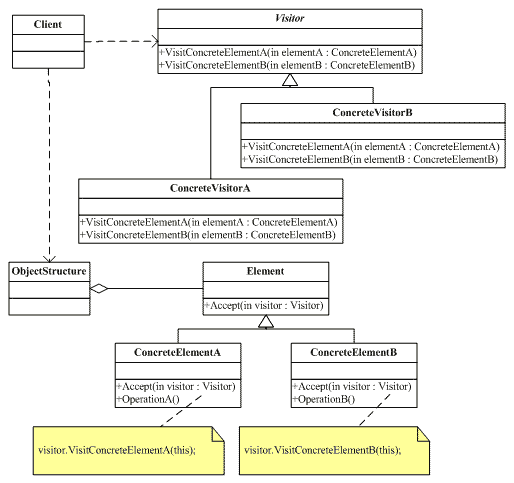
Accept(Visitor) 方法。visitor.Visit(this)。
// Visitor pattern -- Structural example
using System; using System.Collections;

abstract class Visitor {
    abstract public void VisitConcreteElementA(ConcreteElementA e);
    abstract public void VisitConcreteElementB(ConcreteElementB e);
}

class ConcreteVisitor1 : Visitor {
    override public void VisitConcreteElementA(ConcreteElementA e) { Console.WriteLine("{0} visited by {1}", e, this); }
    override public void VisitConcreteElementB(ConcreteElementB e) { Console.WriteLine("{0} visited by {1}", e, this); }
}

class ConcreteVisitor2 : Visitor {
    override public void VisitConcreteElementA(ConcreteElementA e) { Console.WriteLine("{0} visited by {1}", e, this); }
    override public void VisitConcreteElementB(ConcreteElementB e) { Console.WriteLine("{0} visited by {1}", e, this); }
}

abstract class Element { abstract public void Accept(Visitor v); }

class ConcreteElementA : Element {
    public override void Accept(Visitor v) { v.VisitConcreteElementA(this); }
    public void OperationA() {}
}

class ConcreteElementB : Element {
    public override void Accept(Visitor v) { v.VisitConcreteElementB(this); }
    public void OperationB() {}
}

class ObjectStructure {
    private ArrayList elements = new ArrayList();
    public void Attach(Element e) { elements.Add(e); }
    public void Detach(Element e) { elements.Remove(e); }
    public void Accept(Visitor v) { foreach (Element e in elements) e.Accept(v); }
}

public class Client {
    public static void Main() {
        ObjectStructure o = new ObjectStructure();
        o.Attach(new ConcreteElementA()); o.Attach(new ConcreteElementB());
        Visitor v1 = new ConcreteVisitor1(), v2 = new ConcreteVisitor2();
        o.Accept(v1); o.Accept(v2);
    }
}
// Visitor pattern -- Real World example
using System; using System.Collections;

abstract class Visitor { abstract public void Visit(Element e); }

class IncomeVisitor : Visitor {
    public override void Visit(Element e) {
        Employee emp = (Employee)e;
        emp.Income *= 1.10; // 10% 加薪
        Console.WriteLine("{0}'s new income: {1:C}", emp.Name, emp.Income);
    }
}

class VacationVisitor : Visitor {
    public override void Visit(Element e) {
        Employee emp = (Employee)e;
        emp.VacationDays += 3; // 增加 3 天假期
        Console.WriteLine("{0}'s new vacation days: {1}", emp.Name, emp.VacationDays);
    }
}

abstract class Element { abstract public void Accept(Visitor v); }

class Employee : Element {
    string name; double income; int vacationDays;
    public Employee(string name, double income, int vacationDays) {
        this.name = name; this.income = income; this.vacationDays = vacationDays;
    }
    public string Name { get { return name; } set { name = value; } }
    public double Income { get { return income; } set { income = value; } }
    public int VacationDays { get { return vacationDays; } set { vacationDays = value; } }
    public override void Accept(Visitor v) { v.Visit(this); }
}

class Employees {
    private ArrayList employees = new ArrayList();
    public void Attach(Employee e) { employees.Add(e); }
    public void Detach(Employee e) { employees.Remove(e); }
    public void Accept(Visitor v) { foreach (Employee e in employees) e.Accept(v); }
}

public class VisitorApp {
    public static void Main() {
        Employees e = new Employees();
        e.Attach(new Employee("Hank", 25000.0, 14));
        e.Attach(new Employee("Elly", 35000.0, 16));
        e.Attach(new Employee("Dick", 45000.0, 21));
        Visitor v1 = new IncomeVisitor(), v2 = new VacationVisitor();
        e.Accept(v1); e.Accept(v2);
    }
}
適用場景:
核心優勢:
主要缺點:
決策原則: 僅在「數據結構穩定、操作頻繁變化」時使用。若節點類頻繁新增,請避免訪問者模式。