二元樹平均深度為 O(log N)。二元搜尋樹在二元樹基礎上增加有序性質:對任意節點 X,左子樹所有鍵值 < X,右子樹所有鍵值 > X。此性質保證中序遍歷產生遞增序列,支援高效查找、插入、刪除操作。
template <typename Comparable>
struct BinaryNode {
    Comparable element;        // 節點鍵值
    BinaryNode* left;          // 左子節點
    BinaryNode* right;         // 右子節點
    int count;                 // 相同鍵值出現次數(支援重複鍵)

    BinaryNode(const Comparable& e, BinaryNode* lt, BinaryNode* rt, int c)
        : element(e), left(lt), right(rt), count(c) {}
};template <typename Comparable>
class BinarySearchTree {
public:
BinarySearchTree(); // 預設建構
BinarySearchTree(const vector<int>& v); // 由向量建構
BinarySearchTree(const BinarySearchTree& rhs); // 拷貝建構
~BinarySearchTree(); // 解構函數
const BinarySearchTree& operator=(const BinarySearchTree& rhs); // 賦值運算子
void preOrderPrintTree() const; // 遞增序列輸出(中序遍歷)
void inOrderPrintTree() const; // 遞減序列輸出(逆中序遍歷)
Comparable findMin() const; // 最小值
Comparable findMax() const; // 最大值
bool contains(const Comparable& x) const; // 查找
bool isEmpty() const; // 空樹判斷
void makeEmpty(); // 清空樹
void insert(const Comparable& x); // 插入
void remove(const Comparable& x); // 刪除
private:
BinaryNode<Comparable>* root;
// 內部遞迴輔助函數...
};template <typename Comparable>
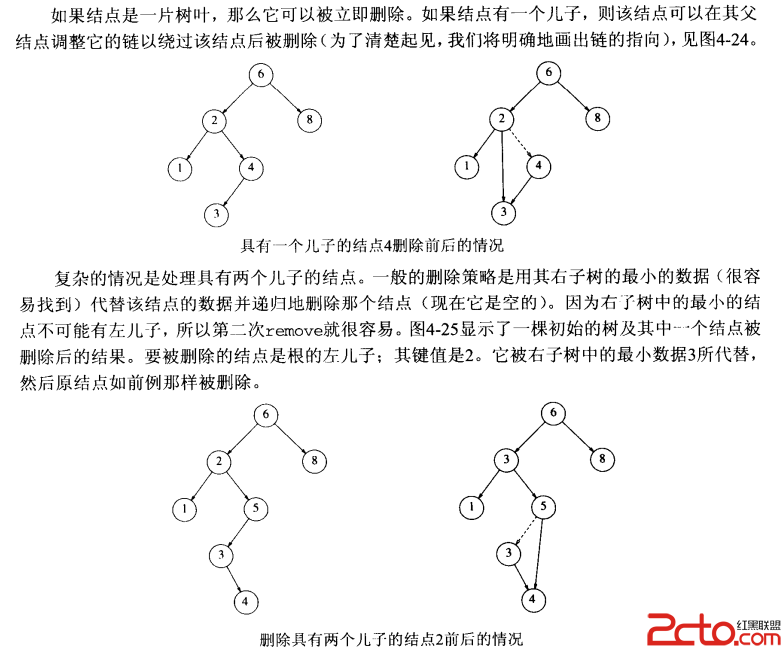
void BinarySearchTree<Comparable>::remove(const Comparable& x, BinaryNode*& t) const {
if (t == nullptr) return; // 空樹
if (x < t->element)
remove(x, t->left); // 往左子樹
else if (x > t->element)
remove(x, t->right); // 往右子樹
else if (t->left != nullptr && t->right != nullptr) { // 兩個子節點
t->element = findMin(t->right); // 右子樹最小值覆蓋
remove(t->element, t->right); // 刪除該最小節點
} else { // 0 或 1 個子節點
BinaryNode* oldNode = t;
t = (t->left != nullptr) ? t->left : t->right; // 子節點頂替
delete oldNode;
}
}
template <typename Comparable>
void BinarySearchTree<Comparable>::insert(const Comparable& x, BinaryNode*& t) const {
    if (t == nullptr)
        t = new BinaryNode(x, nullptr, nullptr, 1); // 建立新節點
    else if (x < t->element)
        insert(x, t->left);
    else if (x > t->element)
        insert(x, t->right);
    else
        t->count++;                                // 重複鍵值計數器遞增
}template <typename Comparable>
const Comparable& BinarySearchTree<Comparable>::findMin(BinaryNode* t) const {
if (t->left == nullptr) return t->element;
return findMin(t->left); // 持續往左
}
template <typename Comparable>
const Comparable& BinarySearchTree<Comparable>::findMax(BinaryNode* t) const {
if (t->right == nullptr) return t->element;
return findMax(t->right); // 持續往右
}template <typename Comparable>
BinaryNode<Comparable>* BinarySearchTree<Comparable>::clone(BinaryNode* t) const {
if (t == nullptr) return nullptr;
return new BinaryNode(t->element, clone(t->left), clone(t->right), t->count);
}
template <typename Comparable>
const BinarySearchTree<Comparable>& BinarySearchTree<Comparable>::operator=(const BinarySearchTree& rhs) {
if (this != &rhs) {
makeEmpty(); // 釋放舊資源
root = clone(rhs.root); // 深拷貝新資源
}
return *this;
}// 中序遍歷:左-根-右,產生遞增序列
template <typename Comparable>
void BinarySearchTree<Comparable>::preOrder(BinaryNode* t) const {
if (t != nullptr) {
preOrder(t->left);
for (int i = 0; i < t->count; ++i) cout << t->element << " ";
preOrder(t->right);
}
}
// 逆中序遍歷:右-根-左,產生遞減序列
template <typename Comparable>
void BinarySearchTree<Comparable>::inOrder(BinaryNode* t) const {
if (t != nullptr) {
inOrder(t->right);
for (int i = 0; i < t->count; ++i) cout << t->element << " ";
inOrder(t->left);
}
}int main() {
// 測試基本操作
BinarySearchTree<int> tree;
vector<int> data = {6, 2, 1, 4, 3, 8};
for (int x : data) tree.insert(x);
cout << "中序遍歷(遞增): "; tree.preOrderPrintTree(); // 1 2 3 4 6 8
cout << "逆中序(遞減): "; tree.inOrderPrintTree(); // 8 6 4 3 2 1
// 測試刪除葉子節點
tree.remove(4);
tree.preOrderPrintTree(); // 1 2 3 6 8
// 測試刪除單子節點
BinarySearchTree<int> tree2;
for (int x : {6, 2, 1, 5, 3, 4, 8}) tree2.insert(x);
tree2.remove(2); // 節點 2 有左子節點 1
tree2.preOrderPrintTree(); // 1 3 4 5 6 8
// 測試拷貝建構與賦值
BinarySearchTree<int> tree3 = tree; // 拷貝建構
BinarySearchTree<int> tree4; tree4 = tree; // 賦值運算子
return 0;
}| 操作 | 平均情況 | 最壞情況 | 空間 |
|---|---|---|---|
| 查找 | O(log n) | O(n) | O(h) 遞迴棧 |
| 插入 | O(log n) | O(n) | O(h) |
| 刪除 | O(log n) | O(n) | O(h) |
| 遍歷 | O(n) | O(n) | O(h) |
最壞情況發生於樹退化為鏈表(有序插入),平衡樹(AVL、紅黑樹)可保證 O(log n)。
lower_bound/upper_bound