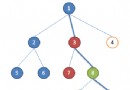
給定平面點集(以字符串 "x1,y1,x2,y2,..." 形式輸入),判斷能否構成凸多邊形,若能則按順時針順序輸出,起始點為距離原點最近的點(最近點不唯一時任選一個)。若存在三點共線或無法構成凸多邊形,輸出 ERROR。
Point(x, y),點數 ≥ 3。ERROR。P0(比較平方距離避免開根號)。P1,建立初始有向邊 P0 → P1。Pi,對當前邊鏈 L 依次判斷 Pi 相對邊的位置:
Pi 在某邊 Lk (A→B) 的左側,則將 Lk 拆分為 A→Pi、Pi→B 插回鏈中(保持順時針序)。Pi 在所有邊的右側,則接在鏈尾(尾點 → Pi)。尾點 → P0 閉合。ERROR。向量叉積為 0:(B - A) × (P - A) == 0。代碼中用斜率比較並處理垂直線(分母為 0)特殊情況。
對有向邊 A→B,點 P 在左側 ⇔ 叉積 (B - A) × (P - A) > 0。代碼通過比較 P.x 與線上同 y 座標處的 x 實現(避免浮點誤差用 float 斜率)。
package com.justinsoft.polygon.model;

public class Point implements Comparable {
    private final int x, y;
    private final int dist2; // 距離原點平方

    public Point(int x, int y) {
        this.x = x; this.y = y;
        this.dist2 = x * x + y * y;
    }
    public int getX() { return x; }
    public int getY() { return y; }
    public int getDist2() { return dist2; }

    @Override public int compareTo(Point o) { return Integer.compare(dist2, o.dist2); }
    @Override public String toString() { return "Point[x=" + x + ",y=" + y + "]"; }
} package com.justinsoft.polygon.model;
public class Line {
private final Point start, end;
private final float slope; // 斜率,垂直線標記為 0 並另行處理
public Line(Point s, Point e) {
this.start = s; this.end = e;
this.slope = calcSlope(s, e);
}
private static float calcSlope(Point a, Point b) {
int dx = b.getX() - a.getX();
int dy = b.getY() - a.getY();
return dx == 0 ? 0 : (float) dy / dx;
}
// 點是否在線上
public boolean contains(Point p) {
float k = calcSlope(p, start);
if (k == 0) { // 垂直線或水平線特判
int dx = p.getX() - start.getX();
return dx == 0 ? p.getX() == end.getX() : p.getY() == end.getY();
}
return k == slope;
}
// 點是否在線左側(順時針多邊形內部在右側)
public boolean hasLeftPoint(Point p) {
if (slope == 0) { // 垂直線
return end.getX() == start.getX() ? p.getX() < start.getX() : p.getY() < start.getY();
}
// 線上對應 p.y 的 x 座標
float xOnLine = (p.getY() - start.getY()) / slope + start.getX();
return p.getX() < xOnLine;
}
public Point getStart() { return start; }
public Point getEnd() { return end; }
public float getSlope() { return slope; }
}package com.justinsoft.polygon;
import com.justinsoft.polygon.model.*;
import java.util.*;
public class PolygonSort {
private static final String ERR = "ERROR";
private static final String SEP = ",";
public static String findConvexPolygon(String input) {
try {
List pts = parse(input);
if (hasCollinear(pts)) return ERR;
Point p0 = Collections.min(pts); // 最近原點
pts.remove(p0);
Point p1 = pts.remove(0); // 任取一點
List chain = new ArrayList<>();
chain.add(new Line(p0, p1));
for (Point p : pts) insertPoint(chain, p);
// 閉合
chain.add(new Line(chain.get(chain.size()-1).getEnd(), p0));
if (!isConvex(chain)) return ERR;
return format(chain);
} catch (Exception e) { return ERR; }
}
private static List parse(String s) {
String[] a = s.split(SEP);
if (a.length % 2 != 0 || a.length < 6) throw new IllegalArgumentException();
List res = new ArrayList<>();
for (int i = 0; i < a.length; i += 2)
res.add(new Point(Integer.parseInt(a[i]), Integer.parseInt(a[i+1])));
return res;
}
private static boolean hasCollinear(List pts) {
List tmp = new ArrayList<>(pts);
for (int i = 0; i < tmp.size(); ++i) {
Point a = tmp.get(i);
for (int j = i+1; j < tmp.size(); ++j) {
Line L = new Line(a, tmp.get(j));
for (int k = j+1; k < tmp.size(); ++k)
if (L.contains(tmp.get(k))) return true;
}
}
return false;
}
private static void insertPoint(List chain, Point p) {
for (int i = 0; i < chain.size(); ++i) {
Line L = chain.get(i);
if (L.hasLeftPoint(p)) {
chain.remove(i);
chain.add(i, new Line(p, L.getEnd()));
chain.add(i, new Line(L.getStart(), p));
return;
}
}
// 全在右側 -> 接尾部
chain.add(new Line(chain.get(chain.size()-1).getEnd(), p));
}
private static boolean isConvex(List chain) {
List all = new ArrayList<>();
for (Line L : chain) all.add(L.getStart());
for (int i = 0; i < chain.size(); ++i) {
Line L = chain.get(i);
boolean hasLeft = false, hasRight = false;
for (Point p : all) {
if (p == L.getStart() || p == L.getEnd()) continue;
if (L.hasLeftPoint(p)) hasLeft = true;
else hasRight = true;
if (hasLeft && hasRight) return false; // 凹
}
}
return true;
}
private static String format(List chain) {
StringBuilder sb = new StringBuilder();
for (Line L : chain) {
sb.append(L.getStart().getX()).append(SEP)
.append(L.getStart().getY()).append(SEP);
}
if (sb.length() > 0) sb.deleteCharAt(sb.length()-1);
return sb.toString();
}
} package com.justinsoft.polygon;
import org.junit.Test;
import static org.junit.Assert.*;
public class PolygonSortTest {
@Test public void test1() { assertEquals("ERROR", PolygonSort.findConvexPolygon("1,2,3")); }
@Test public void test2() { assertEquals("0,0,0,1,1,1", PolygonSort.findConvexPolygon("0,0,1,1,0,1")); }
@Test public void test3() { assertEquals("0,0,0,1,1,1,1,0", PolygonSort.findConvexPolygon("0,0,1,1,0,1,1,0")); }
@Test public void test4() { assertEquals("ERROR", PolygonSort.findConvexPolygon("0,0,1,1,0,3,3,0")); }
}O(n^2)(共線檢測 + 增量插入 + 凸性驗證),n 為點數,滿足題目規模。int,斜率用 float,注意垂直線(dx=0)單獨處理避免除零。O(n^3) 但點數較小可接受;大規模可用凸包算法預處理。