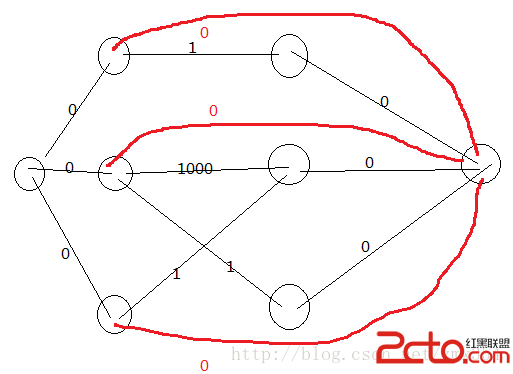
給定夢想與工作的依賴關係,夢想有正權值,工作有正負權值。選擇夢想需完成前置工作。求最大權值和,並在最大權值下求最多正權夢想個數。轉化為最大權閉合子圖問題。
S 連向夢想節點,容量 = dream[i] * C + 1(C=1e6 大常數)。T,若 -work[i] * C;若 i 依賴工作 u,連邊 i → n+u,容量 INF。將點權擴展為 weight * C + (weight>0 ? 1 : 0)。最大流 flow 滿足:
flow / C = 最大權值損失(總正權 - 最大權閉合圖權值)。flow % C = 被迫放棄的正權點數。最終答案:
totalPositive - flow / C。positiveCount - flow % C。typedef long long ll;
const int N = 3010, M = 500010;
const ll INF = 1e18;
template<class T> struct Max_Flow {
int n, Q[N], sign;
int head[N], level[N], cur[N], pre[N];
int nxt[M], pnt[M], E;
T cap[M];
void Init(int n) { this->n = n+1; E=0; fill(head, head+n, -1); }
void add(int u, int v, T c, T rw=0) { ... } // 標準加邊
bool Bfs(int s, int t) { ... } // 分層
void Push(int t, T &flow) { ... } // 增廣
void Dfs(int u, int t, T &flow) { ... } // 尋找增廣路
T Dinic(int s, int t) { ... } // 主流程
};
const ll C = 1e6;
void input() {
    ans = 0; from = 0; to = n+m+1;
    F.Init(to);
    for (i=1; i<=n; i++) {
        scanf("%lld", &dream[i]);
        F.add(from, i, dream[i]*C + 1, 0);
        ans += dream[i];
    }
    for (i=1; i<=m; i++) {
        scanf("%lld", &work[i]);
        if (work[i] >= 0) ans += work[i];
        else F.add(n+i, to, -work[i]*C, 0);
    }
    for (i=1; i<=n; i++) {
        scanf("%d", &siz);
        while (siz--) {
            scanf("%d", &u);
            if (work[u] >= 0) continue;
            F.add(i, n+u, INF, 0);
        }
    }
}

int main() {
    while (~scanf("%d%d", &n, &m)) {
        input();
        ll flow = F.Dinic(from, to);
        cout << ans - flow/C << " " << n - flow%C << endl;
    }
    return 0;
}
C=1e6 需大於最大可能正權點數(n≤3000),保證 flow/C、flow%C 不干擾。ans,不進網絡,簡化圖結構。INF 強制選擇夢想必選工作。O(V²E),實際極快(V≈6000, E≈500000)。C * weight 溢出。此題展示了最大權閉合圖建模與「大常數編碼雙目標」的高級技巧,是網絡流解決組合優化問題的經典範例。